
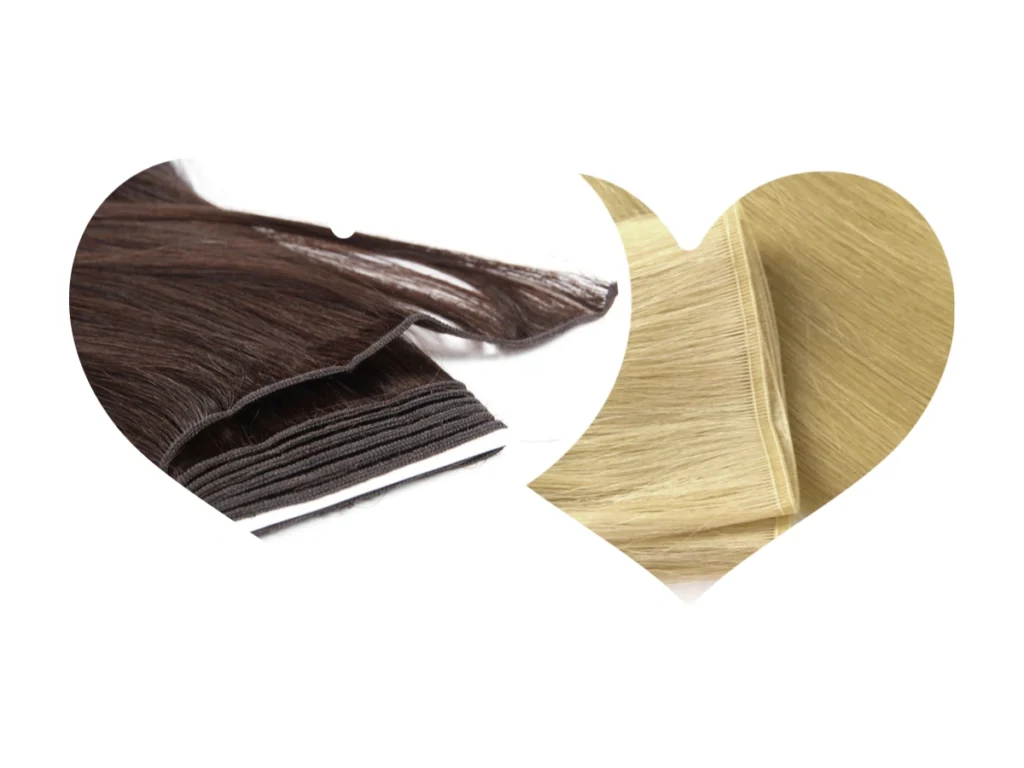
Flat Weft vs Machine Weft Hair Extensions: What’s the Difference?
When choosing professional weft hair extensions, Flat Weft and Machine Weft are two popular options for salons, hair extension specialists, wholesalers, and private-label hair brands.
Both can add length and volume while creating a natural-looking result. However, the construction of the weft track is different, which affects thickness, flexibility, comfort, installation, and the overall wearing experience.
So, what is the difference between Flat Weft vs Machine Weft hair extensions? And when should you choose one over the other?
In this guide, we compare the two weft types in detail and explain why Flat Weft has become an attractive option for professional hair extension businesses.
What Are Machine Weft Hair Extensions?
Machine Weft is one of the most established types of professional weft hair extensions.
During production, human hair is sewn together by machine to form a strong, continuous track. The machine-sewn construction creates a durable weft that can carry a relatively high density of hair.
This makes Machine Weft a versatile option for clients who want to add noticeable length and volume.
For salons and wholesale buyers, Machine Weft Hair Extensions also offer the advantage of being a familiar and widely used extension method.
Key Advantages of Machine Weft
Machine Weft hair extensions are known for:
- Strong and durable construction
- High hair density
- Excellent volume
- Reliable performance for professional installation
- Wide availability of lengths, colors, and textures
- Competitive pricing for salons and wholesale buyers
The main consideration is the thickness of the track.
Because multiple rows of stitching are generally used to secure the hair, a traditional Machine Weft can have a more noticeable seam at the top.
For clients with sufficient natural hair density, this is usually easy for an experienced stylist to conceal. For clients with fine or thin hair, however, the additional bulk may require more careful placement.
What Are Flat Weft Hair Extensions?
Flat Weft hair extensions are designed to provide a thinner, flatter attachment area than a conventional Machine Weft.
Instead of creating a relatively bulky seam at the top, the construction is designed to distribute the hair across a flatter track.
The result is a weft that can sit closer to the head and create less bulk around the roots.
This makes Flat Weft Hair Extensions particularly interesting for professional stylists and hair businesses looking for a combination of:
Volume + Flatness + Comfort + Natural Appearance
The purpose of Flat Weft is not simply to make the weft thinner. A well-designed Flat Weft should provide sufficient strength and hair density while improving the comfort and discretion of the attachment area.
Flat Weft vs Machine Weft: Quick Comparison
Although both products belong to the weft extension category, their different track constructions create several practical differences.
| Feature | Machine Weft | Flat Weft |
|---|---|---|
| Track Construction | Traditional machine-sewn track | Thin, flat track |
| Track Thickness | Generally thicker | Thinner |
| Bulk at the Roots | More noticeable | Reduced |
| Flexibility | Moderate | Generally more flexible |
| Flatness Against Head | Good | Excellent |
| Comfort | Good | Enhanced |
| Hair Volume | Excellent | Excellent |
| Concealment | Good with correct placement | Easier to conceal |
| Best For | Traditional applications and strong volume | Flat, lightweight and discreet applications |
| Market Position | Classic | Premium / upgraded |
The biggest difference is therefore the construction at the top of the weft, rather than simply the quality or length of the hair.
7 Advantages of Flat Weft Hair Extensions
1. Thinner and Flatter Weft Track
The most obvious advantage of Flat Weft is its thinner profile.
Traditional Machine Wefts rely on a machine-sewn seam to hold the hair securely. This provides excellent strength but can create additional thickness at the top.
Flat Weft is designed to minimize this bulk.
When professionally installed, the flatter track can sit closer to the scalp and create a smoother transition between the natural hair and the extensions.
For clients who want volume without a thick attachment area, this can make a significant difference.
2. Less Bulk Around the Roots
Adding volume does not necessarily mean the attachment area should feel bulky.
With traditional wefts, installing multiple rows can increase thickness around the scalp.
Flat Weft helps reduce this effect by keeping the attachment area relatively streamlined.
This allows stylists to create:
Fullness through the lengths while maintaining a flatter root area.
For modern extension applications, this balance between volume and discretion is particularly valuable.
3. More Discreet and Natural-Looking Installation
One of the main objectives of professional hair extensions is to make the attachment as difficult to detect as possible.
A thinner track can be easier to conceal underneath the client’s natural hair.
Because Flat Weft sits closer to the head, there is less raised material at the attachment area.
This can create a smoother overall silhouette and make the extensions less noticeable when the hair moves naturally.
4. Improved Comfort
Comfort is an important factor for clients who wear extensions every day.
A thick or rigid track may be noticeable when the client touches the hair, sleeps, or wears certain hairstyles.
A thinner Flat Weft reduces unnecessary bulk and can follow the shape of the head more naturally.
For clients who are sensitive to bulky attachment areas, this can provide a more comfortable wearing experience.
5. Better Flexibility
The human head is curved, not flat.
For this reason, the flexibility of a weft can influence both installation and comfort.
A flexible Flat Weft can follow the contour of the head more naturally, helping professional stylists position the extension where it is needed.
This can be particularly useful when creating customized installations rather than applying the same weft configuration to every client.
6. A Good Option for Fine or Medium-Density Hair
Clients with fine hair present a particular challenge for extension specialists.
The natural hair needs to conceal the attachment, while the extension should not introduce excessive weight or bulk.
Because of its thinner profile, Flat Weft may be a suitable option for some clients with fine or medium-density hair.
However, Flat Weft should not automatically be considered suitable for every fine-haired client.
The stylist still needs to evaluate:
- Natural hair density
- Hair condition
- Extension weight
- Number of rows
- Placement
- Installation technique
Professional consultation remains essential.
7. Premium Product Positioning
Flat Weft also provides an advantage from a salon, wholesale, or private-label business perspective.
It allows a hair business to offer different levels of weft products rather than relying on a single construction.
For example:
Machine Weft — Classic
Strong, durable, high-volume, and suitable for traditional professional weft applications.
Flat Weft — Premium
Thinner, flatter, and designed for customers who prioritize comfort and a discreet attachment.
This creates a clearer product hierarchy and gives professional buyers more options for different clients and price points.
Is Flat Weft Better Than Machine Weft?
This is one of the most common questions buyers ask.
The answer is:
Not necessarily — they are designed for different priorities.
Flat Weft has clear advantages when the customer is looking for:
- A thinner attachment area
- Less bulk at the roots
- Greater flexibility
- More discreet installation
- Lightweight comfort
- Premium positioning
Machine Weft remains an excellent choice when the priorities are:
- Strong construction
- High density
- Maximum volume
- Traditional weft installation
- Competitive pricing
- A familiar product for professional stylists
Rather than asking which product is universally better, a more useful question is:
Which weft is better for this particular client and installation?
Is Flat Weft Good for Fine Hair?
Flat Weft can be a good option for some clients with fine hair because the thinner track reduces bulk and can be easier to conceal.
However, the thickness of the track is only one factor.
The total weight of the extensions, the strength of the client’s natural hair, the number of rows, and the installation method are equally important.
A thin weft that is too heavy for the client’s natural hair is not automatically a good choice.
For this reason, professional stylists should select the appropriate weight and placement according to the individual client’s hair.
Is Machine Weft Still Worth Choosing?
Absolutely.
The emergence of thinner weft constructions does not make Machine Weft obsolete.
Machine Weft remains popular because it combines durability, density, versatility, and value.
For clients with medium to thick natural hair who want significant volume, a professionally installed Machine Weft can still be an excellent solution.
For wholesalers and salons, maintaining a Machine Weft Extensions collection also makes commercial sense because it serves customers who prefer traditional weft construction.
Which Weft Should Salons Choose?
For many professional salons, the best answer is to offer both.
Choose Machine Weft when the client wants strong volume, prefers traditional weft construction, or needs a cost-effective professional solution.
Choose Flat Weft when the client prioritizes a thinner attachment, reduced bulk, flexibility, comfort, and a more discreet result.
Having both options allows the stylist to choose the product according to the client’s hair rather than forcing every client into the same extension system.
What Should Wholesale Buyers Look for in a Flat Weft?
For wholesalers, distributors, salons, and private-label hair brands, evaluating Flat Weft requires more than simply checking whether the track looks thin.
Several specifications deserve attention.
Track Thickness
The weft should maintain a consistently thin and flat profile.
Track Strength
Reducing thickness should not make the weft unstable. Construction quality remains important for professional use.
Shedding Control
The weft should be designed to minimize shedding during normal professional use and maintenance.
Flexibility
The track should be flexible enough to follow the shape of the head comfortably.
Hair Density
Hair should be distributed consistently across the weft without obvious weak or overly dense areas.
Human Hair Quality
A thin track cannot compensate for poor-quality hair. The hair itself should remain soft, manageable, and consistent after normal washing and maintenance.
Color Consistency
For repeat wholesale orders, reliable color matching is particularly important.
These factors are especially relevant for private-label brands because product consistency affects both salon satisfaction and repeat orders.
Flat Weft vs Machine Weft: Final Verdict
Machine Weft and Flat Weft both have an important place in the professional hair extension market.
Machine Weft is the classic choice for buyers who prioritize durability, density, volume, and value.
Flat Weft is a more refined option for buyers who prioritize a thinner profile, reduced bulk, flexibility, comfort, and discreet installation.
The key difference can be summarized simply:
Machine Weft focuses on proven strength and volume.
Flat Weft combines volume with a thinner, flatter attachment.
For salons and hair extension businesses, offering both products provides greater flexibility and makes it possible to recommend the appropriate weft according to each client’s natural hair and desired result.
Explore Professional Weft Hair Extensions
Ideal Girl Hair supplies human hair extensions for professional salons, wholesalers, distributors, and private-label hair businesses.
Explore our Machine Weft Hair Extensions for traditional, durable weft options, or discover our Flat Weft Hair Extensions for a thinner and flatter alternative.
Different lengths, colors, textures, and product specifications are available for professional and wholesale requirements.
Contact Ideal Girl Hair to discuss samples, wholesale pricing, customized specifications, OEM, and private-label hair extension solutions.

